



Drawing Circles in a World of Straight Lines
Anoush Arshakyan
There is a moment in every fabrication lab when you stand in front of a machine and realize that it is more than a tool. It represents a decision: what we choose to make, and how that choice shapes the material world around us.
Working for years in Fab Lab Armenia, between mountains, forests, and small cities, I have encountered this question repeatedly. Circular economy, in this context, is not an abstract concept or a diagram of arrows forming closed loops. It is the awareness that every material we use, every object we fabricate, continues its life beyond the moment of creation.
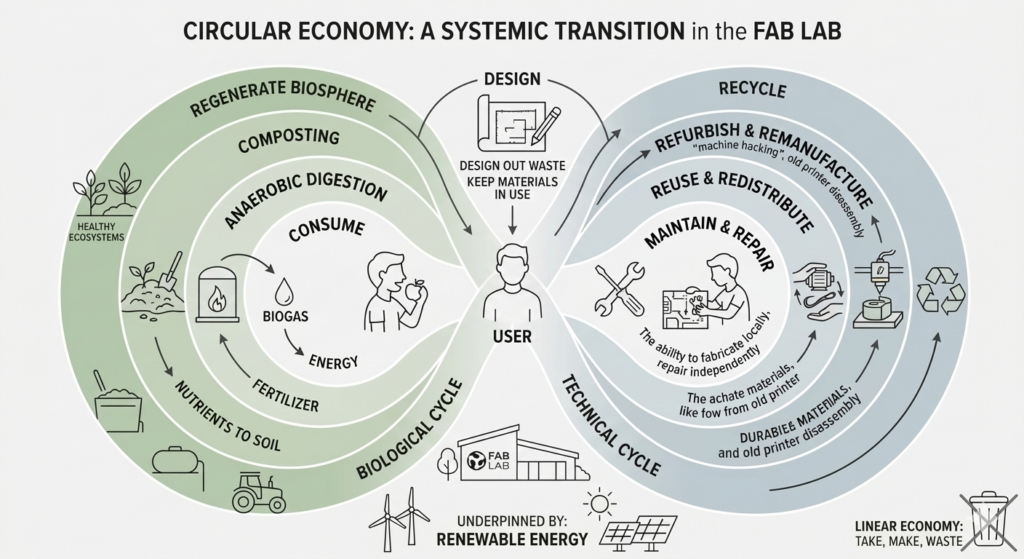
Our industrial systems are largely built on linear logic: extract, produce, consume, discard. This sequence has driven technological progress for decades, but it leaves little space for continuity. Natural systems operate differently. Materials circulate through cycles where waste from one process becomes the resource for another.
The question that increasingly shapes our work in digital fabrication is whether making can follow similar principles — whether the tools and methodologies we use can support systems where materials, components, and knowledge remain in circulation rather than ending their life as waste.
Fab Lab Armenia as a Regenerative Space
In Fab Lab Armenia, digital fabrication is not only about precision or innovation. It is about redesigning our relationship with production itself.
When you work in a small country like Armenia, where supply chains can be fragile and borders unpredictable, autonomy becomes more than an abstract concept. The ability to fabricate locally, repair independently, and adapt machines to context is a form of resilience.
Circular economy begins with this autonomy.
Fab Academy: Closing the Loop Through Understanding
During Fab Academy, weekly assignments reveal an important truth: systems are interconnected. Electronics influence mechanics. Design affects material choice. Programming shapes behavior. Nothing stands alone.
This systemic thinking is the intellectual foundation of circular economy.
If we design without considering maintenance, we create future waste. If we choose materials without imagining their afterlife, we postpone responsibility.
One of the most transformative experiences during the machine building week was when we intentionally disassembled an old printer.
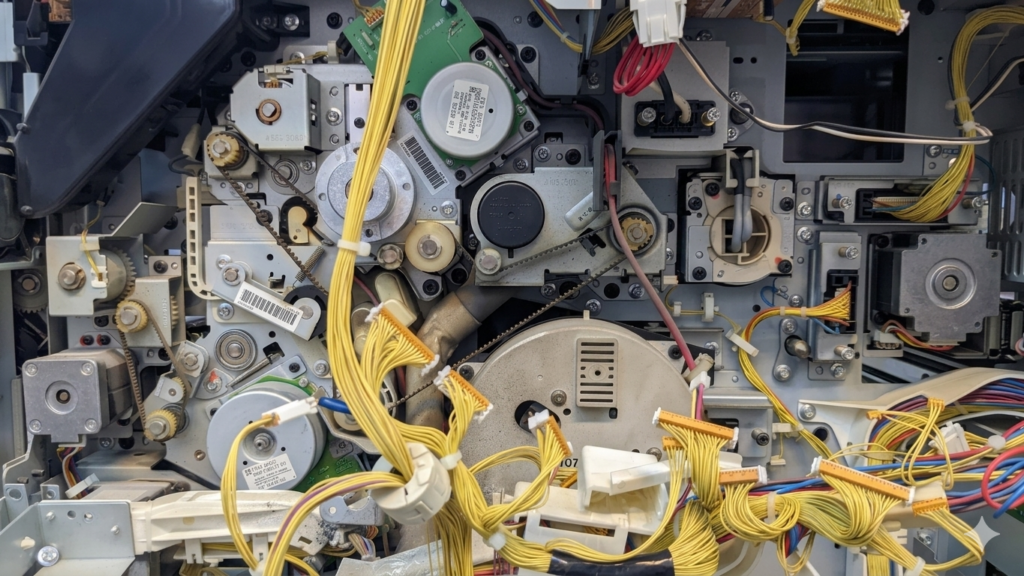
Admiring this engineering masterpiece, a true chef-d’œuvre of mechanics, we carefully removed stepper motors, rods, belts, bearings, and power supplies — components that once served a linear consumer product. Rather than discarding them, we studied each part, learning from the intelligence embedded in its design.
Those stepper motors became the heart of new machines. Those metal rods guided fresh motion systems. Electronic components found new configurations.
That week shifted my perception permanently.
Machine Hacking as a Circular Practice
Machine hacking is one of the quiet ways circular economy already exists in our lab. At Fab Lab Armenia, hacking is not destruction. It is a way of entering into dialogue with machines — opening them, reading their logic, and asking what else they might become.
Some of the machines we encounter are commercial products: efficient, precise, but also closed. Their functions are predefined, their firmware often limiting how far they can evolve. Open-source culture offers another perspective. Instead of fixed tools, machines become systems that can be understood, modified, and gradually transformed.
During Fabricademy 2025, in the Open Source Hardware week, this idea became tangible through a simple experiment. We worked with an old MakerBot 3D printer. The machine still functioned well, but its closed firmware restricted how we could interact with it. The first step was to open it digitally by replacing the proprietary firmware with an open one, giving us greater control over its movements.
Once the printer became open, we began to rethink its role. A 3D printer already knows how to move precisely in three axes and bring a heated nozzle into contact with material. Working with these existing abilities, the machine was gradually transformed into a vinyl heating device used for soft-robotic fabrication.
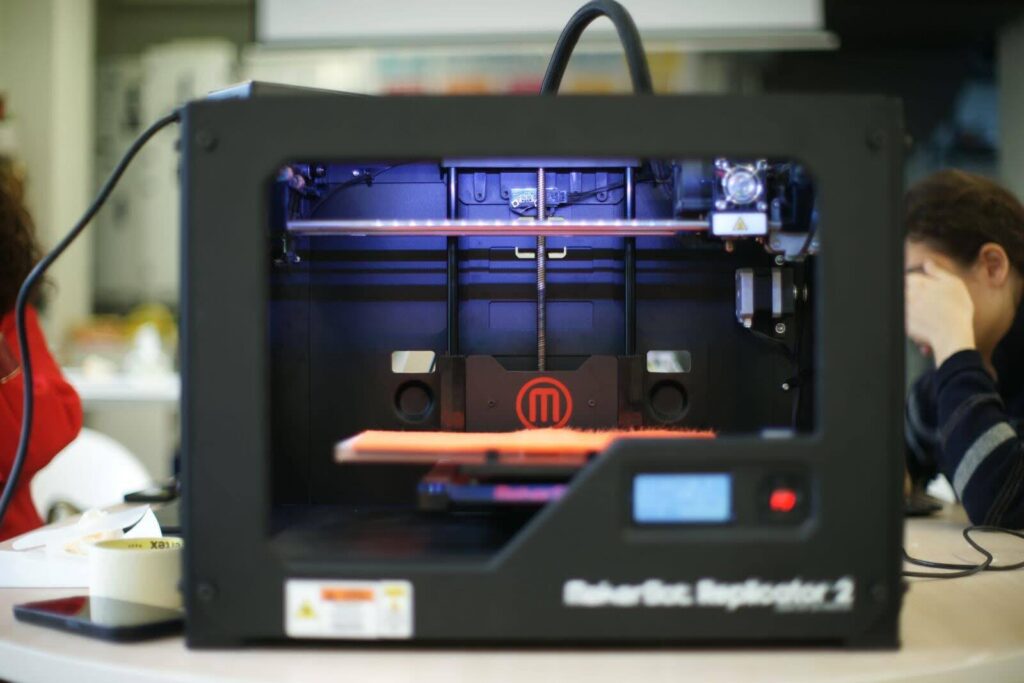
Nothing fundamental changed. The motors, the structure, and the intelligence of the machine simply continued their journey in another form. What once had a single role begins to circulate again through new experiments and new ideas.
Fabricademy: Designing Materials With an Afterlife
If Fab Academy trained my systemic thinking, Fabricademy deepened my sensitivity to matter.
Textiles carry an ancient circular intelligence. Armenian craft traditions never embraced disposability. Wool was spun, dyed with plants, woven, repaired, and transformed. A garment could become a blanket, then insulation, then padding. Materials moved through many lives.
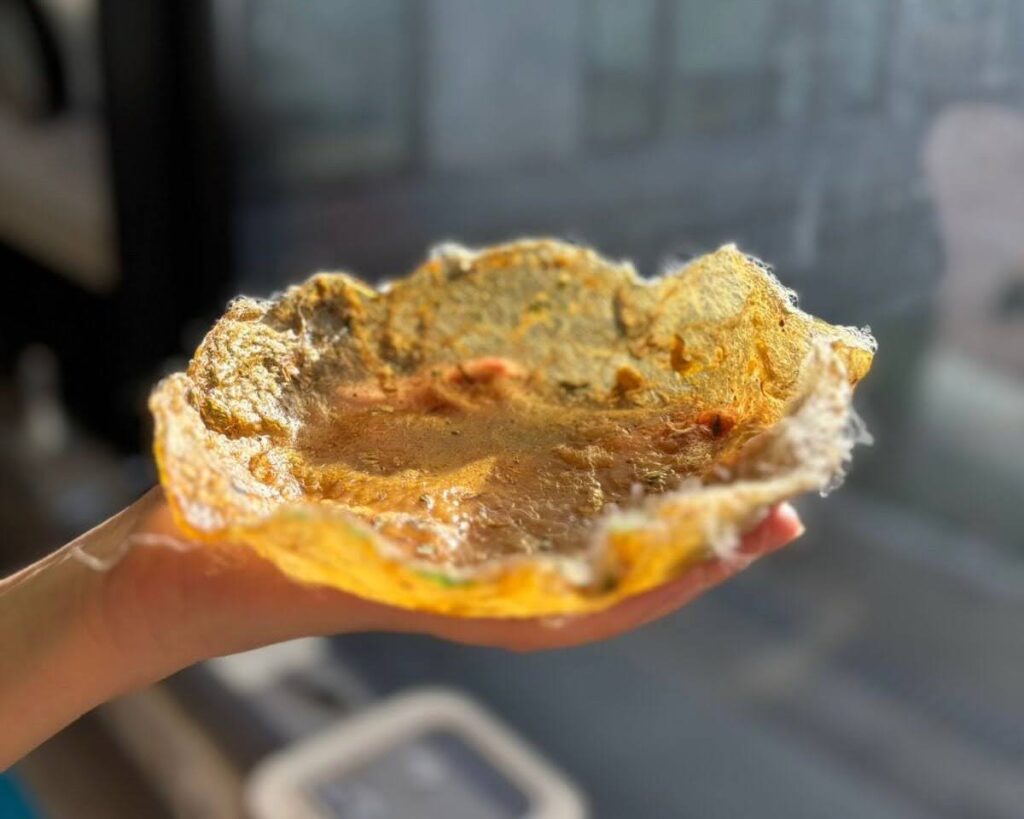
Fabricademy reconnects this ancestral logic with contemporary experimentation. Bio-materials, bacterial cellulose, alginate blends, natural dyes, textile composites — these explorations are attempts to design materials with intention.
When we grow materials instead of extracting them aggressively, we intervene earlier in the cycle. When we design garments that can be disassembled, we anticipate change. When we experiment with compostable composites, we imagine reintegration into ecosystems.
Take a little gelatin, a cup of water, a spoon of glycerin, a handful of clay. Stir the mixture over heat until it becomes smooth and fluid, then pour it out and let it slowly settle into a flexible sheet. Once dry, the material can be cut and assembled — perhaps into a simple card holder that begins its everyday life in someone’s pocket.
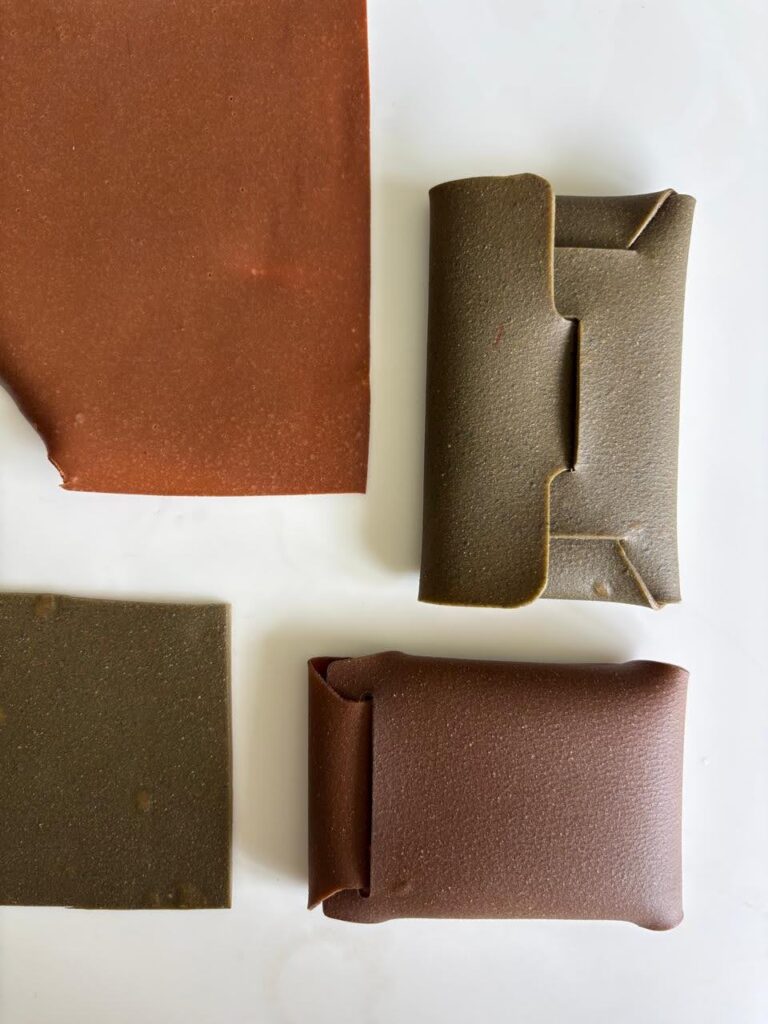
Time passes. The object bends, the edges soften, maybe it cracks. Instead of being discarded, the material returns to the pot. Add a little water, warm it again, and it softens back into a workable substance. Poured, molded, and cut once more, the same material takes shape again — a card holder reborn from the same small recipe.
An endless production cycle, where materials do not disappear but simply continue their transformation.
Small Cities and Visible Consequences
In smaller cities, the consequences of material use are visible. You see landfills, abandoned infrastructure, plastic trapped in rivers. These realities are not abstract; they are part of the daily landscape. But alongside them, you also see craftsmanship — people who know how to mend, adapt, and reuse. You see resourcefulness rooted in necessity.
At Fab Lab Armenia, this visibility shapes our practice. Leftover plywood, acrylic, leather, and bio-fabricated sheets from our own projects are carefully saved and reintegrated into new experiments. Nothing is discarded without thought; every remnant becomes a material opportunity.
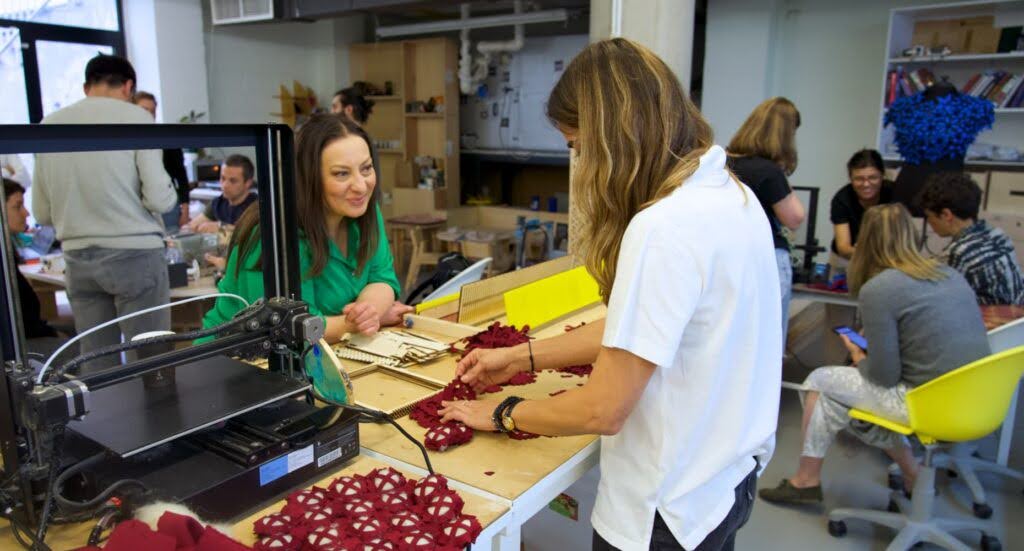
When designing a new object, these scraps are the starting point. Students and community members learn to work step by step, integrating remnants into their creations. Each reuse demonstrates that materials circulate, changing form and function while retaining their value.
This approach embodies a core principle of the Fab Lab mindset: make more with less. Working with what is already at hand fosters creativity, resourcefulness, and careful planning. Every project becomes a lesson in care, efficiency, and possibility, showing that even small actions — reusing, recutting, reshaping — can keep materials and ideas circulating, locally and sustainably.
Education as Circulation
Education itself can be linear or circular.
In a linear model, information flows from teacher to student and stops. In Fab Academy and Fabricademy, knowledge circulates. Students document their processes openly. Others replicate, modify, improve. Ideas evolve.
Open documentation reduces intellectual waste. It prevents repetition without learning. It accelerates adaptation.
When a student in Armenia publishes documentation, someone across the world can build upon it. When we adopt improvements from others, we shorten our development cycles and reduce unnecessary material experimentation.
Knowledge loops globally while production remains local.
This balance is powerful.
Beyond Recycling
Recycling is often presented as the solution. In reality, it is a last resort.
A stronger circular approach prioritizes:
– Refusing unnecessary production.
– Reducing material intensity.
– Designing modular systems.
– Enabling maintenance.
– Reusing components.
– Reconfiguring existing resources.
Digital fabrication tools give us the capacity to intervene at the design stage. We can prototype thoughtfully. We can test durability. We can design for disassembly. We can fabricate on demand instead of mass producing without context.
Circular economy is not only about managing waste. It is about designing beginnings differently.
A Personal Commitment to Circles
Every time I press “start” on a machine, I pause
– Is this the beginning of a straight line? Or part of a circle?
Circular economy is an ethical orientation. It influences how we design, teach, fabricate, and even purchase.And perhaps the future will not be defined by how much we produce, but by how intelligently we circulate.

Anoush Arshakyan
Creative technologist and educational leader working at the intersection of art, technology, and material innovation. She is the Creative Content Developer at Fab Lab Armenia Education Foundation and Program Lead of Fabricademy – Textile and Technology Academy. A graduate of Fab Academy and Fabricademy, she works with digital fabrication, e-textiles, flexible sensors, and interactive environments, developing educational frameworks that connect technology, culture, and artistic experimentation.